Showing posts with label Pilates for the people. Show all posts

4/12/11

Decent Mom Posture: The Roller/Pinky Ball Cult

I thought I could get through doing my posture series without doing this but I can't go any further without introducing you to two of my best friends:


I love a good massage. I used to give a couple a day, up to 6 days a week. I used to receive at least one a week. Massage was a huge part of my life and I deeply believe in its ability to alleviate pain, resolve postural issues and support a positive mood.

However.

Damn if it isn't expensive and time consuming and darn near impossible to get a massage as often as one would like, am I right?

So, in addition to stretching and strengthening, I do a TON of self-massage and I'm going to teach you how to do some on yourself, too.

Releasing tension from muscles is a great accompaniment to stretching (and strengthening). You know those muscles that are clenched so tight they resist even your kindest, most persistent stretches? Try massaging those puppies first. They might be more likely to let go, easily, all on their own.

The first thing I always start with are my feet. Every mother I know is on her feet All. Day. Long. Whether you are in an office or "at home", you probably rarely sit down. So be kind to your feet. They are the basis for good posture and a youthful gait.

I use a Super Pinky ball. It's softer than a tennis ball but about the same size. I know other folks love tennis balls or even golf balls but they're too hard for me.

Stand barefoot, weight on both feet. Place the pinky ball under your foot, just in front of your heel and try to rest as much weight as possible onto the ball. Imagine you are standing equally on both feet, even if that's not exactly p0ssible. Hold it there for at least 30 seconds. Breathe.


Slowly move it to the center of your arch, equidistant between your heel and your toes. Breathe.


Lastly, rest your heel down and let the pinky ball press into the ball of your foot. You will most likely also get a killer calf stretch.


You can finish up with a slow roll from heel to toe, pausing wherever you've got crunchy stuff. Like all massage, it should only be a good, deep pressure that you can relax into, not painful. With that said, don't be afraid to FEEL some serious crap in those feet of yours.

My favorite part? After rolling out only one foot, stand on both legs and close your eyes. Feel the difference between the two and let your mind be blown.

The pinky is awesome for so many things. Try sitting up and placing it under one butt cheek. Massage around until you find a tender spot and then pause and breathe.

You can also place it between your back and the wall and massage your lower back (on either side of your spine), and between your shoulder blades and your spine. Ahhhh.....

Okay, next up: the roller.

I love this thing. It's easy to find at medical supply places and most gyms have them these days.
Buy it for this stretch alone:


Lie on your back with the roller along the center of your spine (you can't quite see it in the photo but my head is on the roller as well.) Open your arms out like you're making snow angels until you find a spot where you feel the deepest stretch. Hang out there and breathe until you're positive your arms are going to fall off your body. To get off the roller, slowly lower yourself to the side rather than trying to sit straight up.

Use the roller for self massage of your back.

(Why yes, Z took these photos too, just like last week! And these are the same pants! I love 'em!)

Keep your bottom off the floor and your head supported by your hands. Roll forward and back, pushing with your feet. (Yep, your abs work a little in this one.)

Pause with the roller under your shoulder blades, lower your hips to the floor and let your back drape over the roller.
(And yes! That is a padded bra!)

Last but certainly not least, try rolling out your IT bands. These thick bands of connective tissue run along the length of your outer thighs.

(Hey Z. Hold the camera still and then push the shutter.)
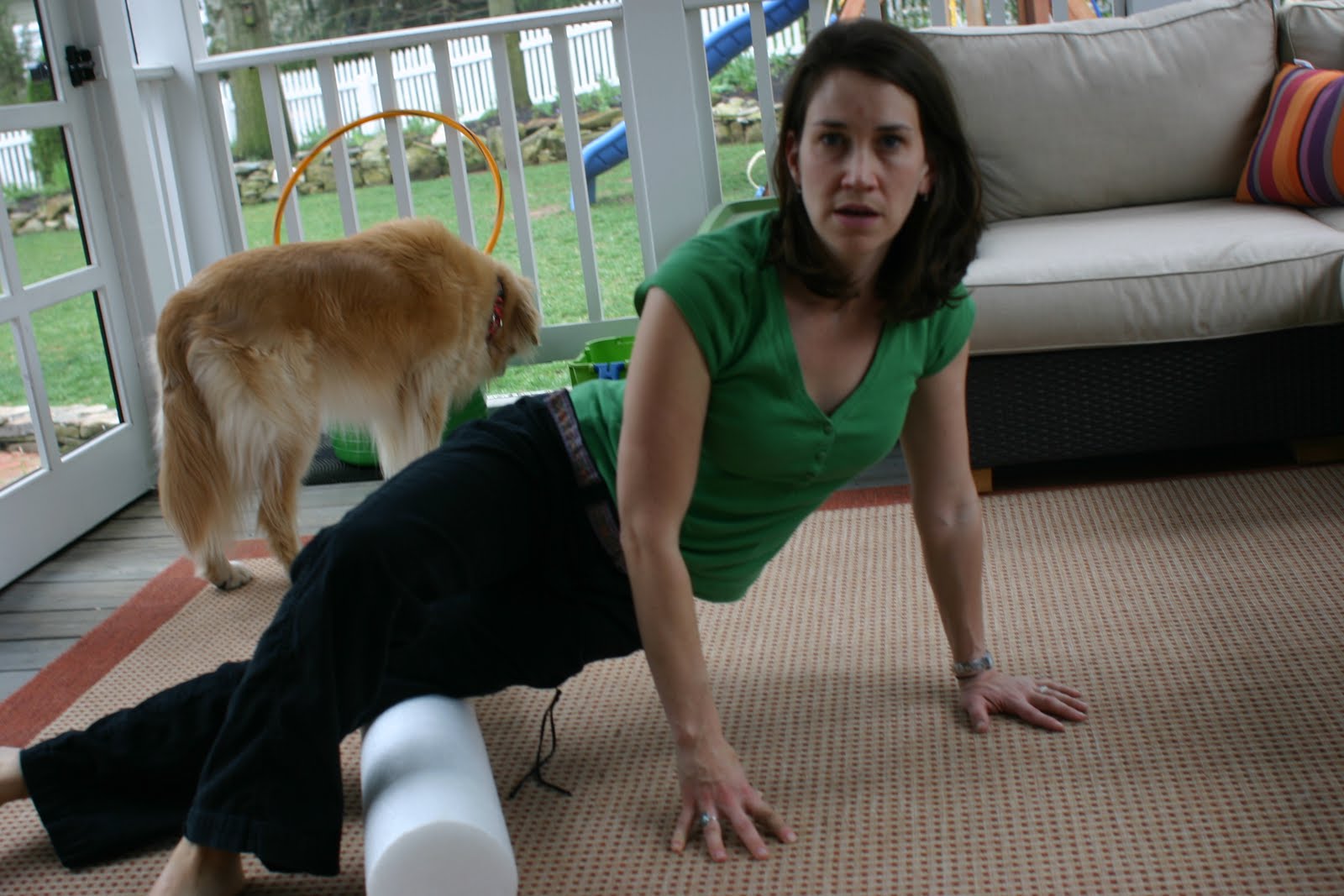
Slowly roll from just above your knee to the very top of your hip, keeping the pressure toward the front of your leg. The top leg is bent so you can take some of the weight if it's too much on your bottom leg. Also, feel free to drop onto your elbows if this is rough on your wrists.

Unfortunately, unlike everything else I'm recommending to you, if you find this excruciatingly painful, you're doing it right. Just know that it's really good for the health of your hips, knees and back to soften and lengthen your IT bands and they just don't stretch well. Massaging them, while painful, is very helpful.

4/11/11

Decent Mom Posture, Step One: Stretch what's tight

So I started last Monday begging you not to hunch over your stroller (or grocery cart) and haranguing you to sit up straight at the computer.

Why yes, I HAVE turned into your mother!

Remember, mothers are always right! (I can say that now that I am one.)

Today, we're going to talk about stretching muscles that tend toward tightness in pregnancy. As noted in the previous post's comments, stretches specifically for nursing mothers that focus on neck and shoulders can be found here.

In attempting to list stretches for transitioning your posture out of the childbearing slouch, I need to generalize, so focus on what is true for your body and realize that if you try the stretch, adjust it a couple of times and it still doesn't do anything for you - hurray! It's possible you don't have a tight muscle there! Go you!

(Or it could mean that that particular stretch doesn't work for you or that I don't know what I'm talking about, which since I haven't worked as a Pilates instructor or massage therapist in years, is entirely possible.)

----------


Stretching your shortened, tight muscles and strengthening the long, weak muscles will make good posture the best kind of habit: effortless, healthy and attractive. By stretching the tight muscles first, you create more space for your joints to align differently and allow the weak muscles to work more easily and safely.

Before any stretching, you should warm up your whole body. Imagine your muscles are taffy: just as warm taffy is more pliable than cold taffy, so too are your muscles. So start by taking a ten minute walk around the block/your house, go up and down a flight of stairs ten times, jog in place for 5 minutes, or dance around your living room to two really great songs (my current favorite warm up songs: "She's Got Me Dancing" by Tommy Sparks and "I've Been Thinking 'Bout Somethin'" by Hanson) (Yes, that Hanson.). Warming up your muscles increases the blood flow to them which allows them to stretch more safely and effectively.

The muscles that generally get tight in pregnancy due to changes in gait and postural stresses include:

1. iliopsoas (hip flexors, deep muscles in the front of your hips)
2. quadraceps (knee extensors, muscles on the front of your thighs)
3. lower back muscles (partiucularly a lovely little guy we'll call the "hip hiker")
4. hip external rotators (deep butt muscles that turn your leg out and result from and/or cause a waddle)
5. hamstrings (backs of thighs)
6. calf muscles (back of calves)
7. pectorals (front of chest))
8. internal rotators of the shoulders (front of shoulders)
9. shoulder elevators (tops of shoulders)

Let's start with the pelvis because it sure goes through the wringer in pregnancy. It's also the center of good posture.

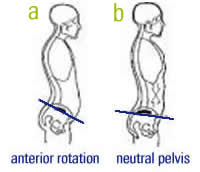
Imagine your pelvis is a bowl. When you're pregnant, the weight of the baby pulls your pelvis forward, spilling the bowl toward your toes. Your abs lengthen and your hip flexors shorten - both significantly. This is called an anterior pelvic tilt (the top of your hips are in front of your pubic bones), and what we hope to achieve is a return to a neutral pelvis (the top of your hips are aligned over your pubic bones).

Image snatched from this website, who swiped it from somewhere else, no doubt.

To address the front of your hips, I like a lunge stretch, and do it often when I'm helping pick up legos, or playing with my kids on the floor, or watching TV.

(What can I say? My kids, husband and friends are all used to me stretching at random intervals.)

Lunge Stretch: Do this either on a soft carpet/mat or with a pillow under your knee. (Notice my house is bit of a mess. I left that all there on purpose. Because this is how it really is: I leave the mess and I stretch on top of bits of playdough and dog hair. Priorities!)


Pictures helpfully, if not totally perfectly, taken by Z.

The most important part of this stretch is how you're aligning your back as you do it. As you sink forward and breathe deeply into the stretch, pull your navel in to support your spine and don't lean back. You should feel this stretch in the front of your hip. Do both sides, imagining that with each breath, the front of your hip gets more and more open.

Now if you want to add some intensity, and a stretch for your quads (the front of your thighs), try bending your back knee and grabbing your foot.

Make sure the pressure is above your kneecap, NOT on top of it.

Next up: Lower back muscles.

As your hip flexors shorten during an anterior pelvis tilt, so do the muscles in your lower back - it's a lovely tug of war. Plus if you have any toddlers/lazy preschoolers (*COUGH COUGH * Z * COUGH*) in your life, you're probably also used to balancing a child on one hip while you cook dinner/shop/fold laundry/talk on the phone/ETC.

Cat/cow from yoga is an easy, gentle way to get your whole spine moving. Repeat a bunch of times, and go slow so you can feel all the spinal joints moving. Remember to keep your shoulders away from your ears and use your belly to pull your navel into your spine as you move into cat.


Mooooooooo.

Meoowwwww.

Rest in child's pose when you're finished.


Next, a gentle twist wrings out your spine.

The most important thing to note about this stretch is to focus the stretch through the whole spine, NOT your neck. The top of your head should be reaching taller and taller as your twist, rather than cranking you around.

From this seated twist, let the top ankle stay crossed over the bottom knee and drop the top knee open (this anchors your hips, increasing the following side stretch.)


Notice that the hip on the side I am stretching is kept down by the weight of my foot that's crossed on top. If you are flexible in this direction, you'll be able to get your elbow down on the ground, otherwise, just side bend and put your hand down. Keep your body stretching just to the side, no leaning back. Pretend you are being pressed between two panes of glass.

From here, transition to a glute stretch by slowwwwwly moving your body around toward the front of the room. (If this is too tight or uncomfortable on your knees, place your "top" foot on the floor in front of the "bottom" foot.) Keep your spine reaching long and your shoulders relaxed away from your ears.

Breathe into your butt. Yes, really.

That waddling duck walk from pregnancy with your feet turned out? Yeah, that certainly tightens up the deep rotator muscles in your butt. That last stretch will address one aspect of that waddle. The next one gets different muscles from different angles.

Start here:
Feet wider than shoulder-distance.


Cross one ankle on top of the opposite knee and drop that knee into toward the center of your body, trying to keep your hips down on the floor. Once again, breathe into your butt.


As part of pregnancy gait, our stride often shortens, which can significantly shorten your hamstrings and calves.

I like to lie down when I stretch my hamstrings (E likes to help me with this one!) You can grab your foot or use a belt. Use your other hand to help keep your waist long and your hip down. After a few breaths where you're pulling your foot toward the same side shoulder, angle your leg across your body, aiming for the opposite shoulder, for a few breaths.


Last up, a slow calf stretch at the wall.


As for the upper body stretches- check out that post I did about Reversing your Baby Holding Hunchback. That's the stuff right there.

Happy Stretching!

(Next up! Strengthening!)

4/4/11

How to stop walking/sitting/standing like a pregnant lady

So you had a baby. Maybe it was a few months ago, maybe it was a few years ago. Either way, your body is yours again.

So how about we make sure you're not still walking/sitting/standing like a pregnant lady?

First off, I need to inform you that I am NOT a doctor of any kind. My training is as a Pilates instructor and massage therapist, so please understand that I can neither diagnose any medical conditions nor give actual medical advice. If you are in pain of any kind, I beg you to see a doctor before listening to me (or any other wacko on the internet). Pain should not be ignored and doctors/chiropractors/physical therapists are qualified to help you.

With that said, can we all agree that doctors are awfully fond of medication and surgeries and not so good at subtlety and health improvement? And what I'm interested in (and vaguely qualified to talk about) is taking careful stock of your body post-baby and improving your muscular balance so that good posture is easy. So if you've already seen a doctor, or you aren't in any pain, let's proceed.

Actually, one last caveat: I am just as in need of this advice as anyone else, so please don't assume I have perfect posture. I have had to adjust my posture 8 billion times in the writing of this post alone!

If you've ever been pregnant, I don't have to tell you that your body undergoes tremendous change during pregnancy - and after. Your posture changes, some muscles tighten, others weaken, your stance and gait are altered both by the weight of your baby/babies and the hormonal changes that accompany pregnancy. Your entire body - just like your life - gets turned inside out by childbearing. Unfortunately, many of the less desirable bodily changes remain after your babe vacates the womb, when you are the least inclined and able to focus on yourself.

In my next post I will be helping you identify which of your muscles are tight and how to stretch them, because when one set of muscles is tight (such as your lower back), the muscles immediately opposite (like, oh say, your abdominals) have a much harder time working properly and progressively weaken. So we'll start with the tight muscles and then a follow up post will help you identify which muscles are weak and some of the best ways to strengthen them.

In the meantime, the first rule of good posture is this: your function becomes your form. That is, how you use your body directly shapes how it looks and feels. When we are children, a slouch can be fleeting, leaving not a single mark behind. The older we get, the stiffer and more restricted our joints get, the more those momentary slouches form your body into that shape until it's uncomfortable - or, even, virtually impossible - to sit up straight.

How you use your body when you are pregnant, or any other time of postural stress, can stick with you. A waddling walk, a poochy stomach, a hunched I've-just-been-nursing-a-bowling-ball posture, can stick around for years, or your whole life, if you don't do something to stop it. Simply sitting up straighter - pelvis underneath your ribcage, head in line with the rest of your spine - is a start. Consider adding a reminder alarm on your computer to remind you to check your posture at regular intervals.

Before I sign off for today, can we talk about walking with a stroller for a second? Ladies, listen up, this is important: your stroller is NOT A WALKER. (And NEITHER IS YOUR GROCERY CART.) You are not an infirm, elderly lady who needs to lean on top of your stroller for dear life. Function becomes form, remember? So hunching over your stroller, for however many minutes/hours/years you do it, molds your upper back into a less than pretty, not to mention potentially damaging, position.

Drop those shoulders, put your elbows in by your waist and let the forward momentum of your whole body propel the stroller rather than the top of your shoulders. Your arms should be relaxed, elbows bent by your sides, as the muscles of your arms and shoulders are not the prime movers of the stroller. Rather, imagine your arms are a passive extension of the motor that is your lower body.

Your assignment: If you push a stroller or a grocery cart in the next few days, drop those shoulders, let your legs and the forward momentum of your pelvis - your whole lower body - propel you both forward.

Lord knows we'll all be pushing walkers soon enough.

7/21/09

Reversing the Baby Holding Hunchback

I was going to call this post "Stretches for the Nursing Mother" because a few friends have asked for them specifically (Hi C! Hi R!) but you certainly don't have to be a mother or be nursing to benefit from these stretches. However, if you happen to be nursing a 12 pounder one-handed while chasing a toddler like I am, you might find yourself craving these stretches on a regular basis.

I was always so careful about my posture when nursing Zoe. I had a spot on the couch all set up with multiple pillows and drinks and snacks and I would stay in one spot, perfectly supported, for the whole nursing session.

Now, I've perfected the art of slumping over to nurse Eliza on my lap while simultaneously wiping Zoe's bum at the same time. Just so you know: NOT SO GOOD.

So. Here are the stretches that I do on a regular basis to help. (Those of you who do Pilates will instantly recognize that NONE of these stretches are classical Pilates. However, what I teach is more of a hybrid of Pilates, yoga and physical therapy exercises and I use these stretches all the time with my clients. They are all great for helping reverse general slumpitude.)

All stretches should be held for 30 seconds-2 minutes and feel good. Please see a doctor before starting any exercise regime BLAH BLAH I'm not a doctor BLAH BLAH please don't sue me BLAH BLAH BLAH.

1. This doorway stretch really opens up your chest and shoulders. Make sure you don't sag in your midsection. Use the 30 second stretch as an opportunity to pull your navel to your spine and hold your core (I know you were just DYING for that opportunity, right?.) (Please excuse the lack of make up here and the apparent face-melting disease. Jeez. When, exactly, did I get JOWLS?)


2. This next stretch also addresses your chest muscles but adds in a stretch for the biceps and forearms which get super tight from holding a baby all day. Hold your best posture through your spine for the entire stretch, no twisting or sagging in your core. (This a recent haircut here and a bad one. What is it about hairdressers that when you say "make the shortest layer shoulder length", they somehow hear that as "ear length"??)


3. The stretch pictured below is a great one to stretch out the back of your shoulders, upper back, neck and forearms. Try to pull your shoulder blades apart and inflate all the little spaces between the ribs in your upper back as you breathe. (I gave up on the hair and put it in a pony tail.)


4. From the above stretch, move into the stretch below. Since I am always gazing down into little faces in my lap, the front of my neck gets super tight. This stretch basically reverses the position I'm in all day and keeps me from getting tension headaches.


5. I LOVE this stretch. It is a great all around body stretch, addressing shoulders, upper back, chest, butt and hamstrings. If I don't have time for anything else, I try to do this one. Once again, keep your core engaged to protect your lower back. It also works well to put your hands on a bathroom/kitchen counter and do this.


6. This next one is a stretch and a strengthening exercise all in one (we Pilates instructors are sneaky that way). Although I appear to be being held up at gun point (and perhaps forced to smile OMG WHAT'S WITH THE SERIOUS FACE AND DEATHLY PALLOR?), I am actually stretching my chest and strengthening my upper back. This exercise looks silly but is quite challenging. Make sure your ribcage stays on the wall and your shoulders are as relaxed as possible. (ie. you aren't wearing them as earrings.)


7. I almost forgot! ("Ma! Would you go get the camera again!?") This is a great one for the whole shoulder-blades-as-earrings issue mentioned above. Notice that my hand is hooked under my seat. You can also just sit on your hand if you are on a couch. Note that the top hand is not pulling on my head, just adding a little weight for extra stretch.


So there you have it. Clueless But Hopeful Mama's tips for reversing your baby holding hunchback. There are a bunch of great ones that are done lying on the floor but since taking those pictures would have involved things like vacuuming up dog hair and clearing a path through the plethora of plastic toys that I swore I would never buy, I decided I'd stick with seated or standing stretches.

(Now if Sunday's picture didn't prove me to be not vain [unvain? vainless?] then these pics surely do. That's how much I love you C and R.)

Happy Stretching!

5/29/09

Getting your belly back after baby

Okay. There's no easy, painless way to do this.

So let's just pull the band-aid off quickly, shall we??


Phew. Okay. I have now officially done it ALL on this blog (Labor story in extreme detail? CHECK. One week post-partum bare belly photo? CHECK.)

(But note: I wore all black for a"slimming effect".)

(Too bad all it slimmed was my flat, flat behind.)

Truth be told, I'm actually a little stunned that I look like this one week post partum. In a good way. Because after Zoe was born I looked 7 months pregnant. FOR ABOUT A MONTH. So to have had a 10 lb baby and look only 4 months pregnant a week later feels a bit like success. (I'm sure all women reading who have never been post partum are a bit horrified by this picture while most women who've had a baby KNOW WHAT I'M TALKING ABOUT. Unless, of course, you are Heidi Klum, in which case, OMG HI HEIDI.)

But I digress.....

Where were we? Oh right. How do we go about regaining our prepregnant posture, supporting our backs and looking NOT PREGNANT, possibly even HOTTTT, after having a baby (or two)?

I am a Pilates trainer. I got my body in decent shape after one baby. I have helped numerous women get in shape after having a baby. So I'm about to practice what I preach. And you poor suckers lucky people get to come along for the ride!

First thing you need to know when trying to get your belly back in shape after having a baby is whether you had a c section or a vaginal delivery. (Duh.) If you had a c section, you're going to have to wait to get your doctor's okay before performing any exercises. If you had a vaginal delivery, you can pretty much have at it as soon as you feel ready.

(All people who are going to attempt to follow my advice should get their head examined doctor's okay first, I'm not a doctor, please sign waiver here, BLAH BLAH BLAH.)

Next, you need to find out if you have a diastasis recti. A diastasis recti is the splitting of your "6 pack" abdominal muscles into two halves. While all pregnant women stretch out these muscles during pregnancy, some of us actually split them into vertical halves (lucky us!). You can check, and correct, for one at any time post partum, even years later.

Checking for Diastasis Recti
*Lie down on your back, knees bent, feet flat on the floor.
*Place your fingertips on your belly right at the midline, above your belly button.
*Lift your head off the floor and press your fingertips into your belly. You are looking to see if they fall into a trough-like space between the two halves of your ab muscles. Measure how many fingers you can fit into the trough. If two or more fingers fit in the trough width-wise, you have a diastasis and will need to start out with simple exercises to encourage the muscles to come back together.
* Repeat, this time with your fingertips below your belly button. Note how many finger widths you can fit in the trough above and below your belly button.

(These exercises are also safe and good for abdominal training at any time. They are great post partum exercises even if you didn't have a diastasis [you can just leave out the bracing part].)

1. Breathing:
*Lying down on your back, knees bent, feet flat on the floor, lower back curve preserved (ie. do not flatten your back into the floor at any time during this exercise).
*Inhale through your nose to prepare.
*Exhale through your mouth and draw your belly into your spine without tipping your pelvis or flattening your back. You are drawing in your deepest abdominal layer, the transversus abdominus, which acts like a natural girdle and is a vital part of spinal stabilization (which we all need when we're hauling around babies and toddlers and carseats and diaper bags and grocery bags and OMG I NEED A SHERPA EVERY TIME I LEAVE THE HOUSE). Imagine you are trying to fit into a tight pair of jeans (which, seriously, you shouldn't do to yourself until at least 6 months post partum so just IMAGINE, k?) Keep neck, shoulders, and bottom relaxed.
* (Note: If you had a vaginal delivery and you had substantial tearing, you will want to wait until your undercarriage heals. There should be NO pain with this exercise, especially in your pelvic floor. Kegels will help return your pelvic floor muscles to full strength. Once you are ready to begin abdominal exercises, imagine the pelvic floor lifting up with each contraction of your deep abdominal muscles.)
*Repeat 20 times.

Once this feels easy, progress to exercise 2.

2. Breathing with abdominal bracing
*Lie down on your back, knees bent, feet flat on the floor, with a long, thin towel (I like to use my bathrobe belt) under your lower back.
*Cross the towel ends in front of your abs at the level of your largest trough and hold one in each hand (When you noted the trough above and below the navel, where was the biggest trough? Start there. If they were even, start at your navel.)

(Worst picture ever but I had to take it myself so there you go.)
*Inhale through your nose to prepare.
*Exhale through your mouth as you draw you belly into your spine and pull the ends of the towel so that your waist is cinched in and the two halves of your abs are brought back together.
*Repeat 20 times.

Once these feel easy, progress to exercise 3.

3. Breathing and bracing with pelvic tilts.

Same as above, except you add a tilting of your pelvis and a flattening of your lower back into the floor, as you exhale and draw the two halves of your abs together and in toward your spine.

Once these feel easy, progress to exercise 4.

4. Breathing and bracing with chest lifts.

Same as #2, except you add a lifting of your head and shoulders as you exhale and draw the two halves of your abs together and in toward your spine. It's like a slow motion "crunch" with your abs being drawn together by the towel/soft belt.

----------

So there you have it. Some exercises that I will start doing, uh, today? Yes, yes, today.

I have a 3 finger width diastasis and have some serious work to do to get these abs back in shape. I am feeling like my undercarriage is healed enough (Did I mention: 10 LB BABY? SUNNY SIDE UP?) to start some of these exercises (along with some Kegels.).

So I start today.

(Now there, seriously, is more than any of you wanted to know about abdominals and pelvic floors, mine in particular. )

(Any questions? Feel free to email me or leave a comment.)

10/4/07

The real mommy makeover.

In today's New York TImes style section, there's an article about mommy makeovers. You know, where they combine all your needs into one! gimmicky! opportunistic! simple! procedure! Tummy tucks, boob lifts, lipo. Even va-j-j beautification surgery. We're all clamoring for these now, I guess.

I don't really care if moms want to get their boobs lifted or tummies tucked. If you are unhappy and have tried other means to reshape your body, knock yourself out. But what goes unsaid in this light article (What did I expect? It's in the "Style" section, after all.) is that there are a few important aspects of post-partum bodies that very few people talk about. And maybe some of these women would feel more confident and sexy if they had some help truly addressing what pregnancy and childbirth do to the way your body functions as well as how it looks.

How about this for a mommy makeover? How about requiring all OB/GYNs to check moms at the 6 week post-partum visit for diastasis recti and pelvic floor strength? And if problems exist in either area, referring to a physical therapist who specializes in post partum women's health? Is that really so difficult?

Depending on who you ask, diastasis recti, which is the separation of your rectus abdominus along the vertical center line of your belly, happens in 50-85% of all pregnant women. And yet, very, very few moms I know have ever heard of it, let alone been checked for it. Why OBs don't routinely check for it is beyond me. If left untreated, the abdominals may never go back together, leaving your belly protruding, your posture unsupported and your spine unprotected. Just going to the gym and doing mindless crunches not only doesn't help, it makes it worse.

Don't know if you have it? Try this test: Lie down on your back with your knees bent, feet flat on the floor. Place one hand on your belly, fingertips together and pointing down toward your feet. Lift your head off of the mat without trying to do anything in particular with your abs (ie. if you know Pilates, don't try to engage your transversus, just lift your head). With your head off the floor, press your fingertips into your belly to see if they fall into a trough-like space between the two halves of your abdominals. If you can get three or more fingers into the trough, you have a disastasis that needs immediate attention. You should take special care when lifting heavy things (as in DON'T DO IT) and you should start on a program of corrective exercises. I won't go into them here but if you don't have the ability to hire a great Pilates instructor or see a physical therapist, there are some good ones on the web. Like here.

Here's where I say that you should see your doctor and I'm not a doctor so don't take my advice as a medical opinion and blah blah blah.

And let's just say that, postpartum, you are peeing yourself, or sex is painful. These are both common symptoms of pelvic floor dysfunction and will mostly likely be helped by seeing a doctor and physical therapist who specialize in treatment of the pelvic floor. For some women, just doing some kegels is enough to get you shipshape again. For others, you may need biofeedback or internal physical therapy (yep, that means just what you think it does). Either way, do not assume that since you had a baby you will just have to live with painful sex or a Costco sized box of pantiliners for the rest of your life.

Now if anyone has any advice about the boob issue, I'm all ears.

Blog Designed by: NW Designs